
Lately, I’ve been spending time learning more about personal finance fundamentals. I mean, we all want to be rich, right? Oh, sorryit’s called wealthy on that other side. Somewhere between budgeting, saving, and investment formulas, one thing quietly stood out, the compounding effect, And yes it is related to compount interest.
It’s not that I hadn’t heard of it before. I remember it from Compound Interest in Mathematics class and other several occasions I just never paid much attention to it beyond calculating the figures and skimming through if it was in reading scenarios.
This time, it felt different because unfortunately I am taking it seriously. Its part of the small things that grow massively huge with time and make the big difference making you wonder why you didn’t start earlier. It reminded me of a line from Richard Hamming’s You & Your Research paper:
“Knowledge and productivity are like compound interest. Given two people of approximately the same ability and one person who works one percent more than the other, the latter will more than twice outproduce the former.”
In retrospect that line lingers, It’s one of those truths that sits between math and philosophy the idea that even the smallest consistent effort, compounded over time, creates disproportionate results.
In finance, compounding is about savings or investments where small amounts accumulate into something significant over time. Think of Warren Buffett ,his early start, consistent investing, and patient building from age 12. Day to day, little seemed to change. But over decades, Berkshire Hathaway emerges a monument to consistency that isnt easily replicable because it takes much time than people give it. Yes, skill and timing matter, but the real engine is the compounding effect of knowledge, belief, discipline, and reinvestment.
Let’s break it down simply: the difference between simple and compound interest is reinvestment, interest earning on interest. The same applies to growth. Every bit of learning, discipline, or progress you feed back into yourself multiplies.
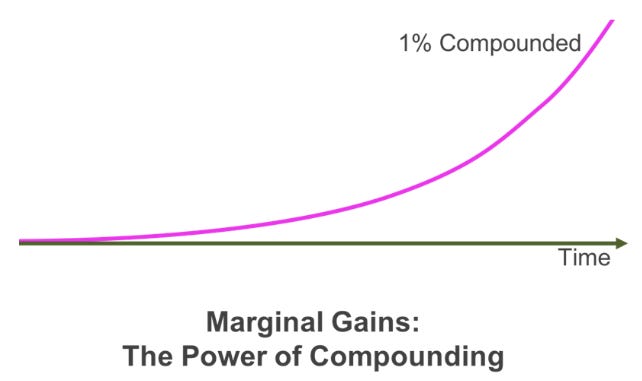
At first, the gains are invisible ,too small to notice. But then, one day, the curve bends upward. And that’s when the magic shows. Maybe compounding isn’t just a financial principle.
Maybe it’s a life strategy.
For financial compounding, take a class, read a book and learn that in your own time.
But for life compounding? Keep going. Keep investing in yourself, your craft, your growth.
Because in the long run, the gap between those who stopped and those who didn’t becomes exponential.
And the difference between the rich and the wealthy?
Let’s just say that’s a story for another day.
Adios.